Education is Key to the North Carolina Economic Innovation, New Report Says
The report tracks the state鈥檚 performance across 42 innovation measures and weighed against those of the country, as well as six key comparison states

;)
Education news and commentary, delivered right to your inbox.
Sign up for 社区黑料 newsletter.
Get stories like this delivered straight to your inbox. Sign up for 社区黑料 Newsletter
was released on July 29 by the North Carolina Department of Commerce’s Office of Science, Technology, and Innovation. As a whole, according to the report, the state is considered to be improving innovation capacity compared to the rest of the country.
Machelle Baker Sanders, North Carolina’s commerce secretary, said in a that the report shows that we must continue to improve the 鈥渓evel of prosperity鈥� throughout the state.
鈥淔aced with a dynamic and competitive economy, the best approach is to shape it rather than be shaped by it. We must continue to innovate — to create and adopt new products, services, and business models that add value and improve economic well-being,鈥� Sanders said.
The report tracks North Carolina鈥檚 performance across 42 innovation measures. Those statistics are then weighed against those of the United States overall and six key comparison states (California, Massachusetts, Georgia, Virginia, Colorado, and Washington). These measures provide insights into the links between innovation, resources, and economic results in the state.
According to the researchers鈥� findings, North Carolina matches or outperforms the United States as a whole in about half of the measured categories.
The report said that North Carolina鈥檚 statewide innovation ecosystem is healthy, and the state has improved since the early 2000s at a rate comparable to the country as a whole. However, the state鈥檚 poverty rate is above the national average, and income and wages of residents are also behind, despite having one of the fastest growing populations.
Janet Cowell, chair of the North Carolina Board of Science, Technology & Innovation, said that technology and innovation are key to a growing economy.
鈥淎s this report shows, North Carolina has achieved a leading role in the 鈥榖asic鈥� and early-stage 鈥榓pplied鈥� research that forms the foundation for breakthrough innovations,鈥� Cowell said in a press release. 鈥淏ut it also shows that we have room for improvement in scaling and converting those innovations to commercial uses and in ensuring that more sectors and regions of our state participate in and benefit from that activity.鈥�
More on the report’s findings
According to the report, both academic and business research and development have grown faster than the national average since 2000, providing a strong foundation for economic growth. North Carolina鈥檚 research and development performs well above the national average, and the state鈥檚 academic institutions generate a significant amount of intellectual property.
North Carolina ranks 16th nationwide for the percentage of people who have jobs related to science and engineering. Researchers considered the following as science and engineering jobs: engineers, and computer, mathematical, life, physical, and social scientists. STEM teachers are not included.
Between 2003 and 2020, the state鈥檚 science and engineering workforce increased by 50%. This is 25 percentage points higher than the national average. But the report also found that the state graduates a lower proportion of science and engineering students compared to other states.
North Carolina ranks 28th in the nation when analyzing the ratio of science and engineering bachelor鈥檚 degrees to the population aged 18鈥�24 years, which “represents the extent to which a state prepares young people to enter technology-intensive occupations that are fundamental to a knowledge-based, technology-driven economy,” the report says. The state鈥檚 results are below the nationwide average, which means there is room for improvement.
People with degrees in computer and mathematical sciences; the biological, agricultural, or environmental life sciences; physical sciences; social sciences; psychology; engineering; and health fields are included in this measure. People who have doctorates from foreign institutions and/or are over the age of 75 are excluded.
The report said the relatively low percentage of trained engineers in North Carolina鈥檚 workforce is a cause for concern because regions with a high concentration of engineers have a greater capacity for innovation and often lead in key industries.
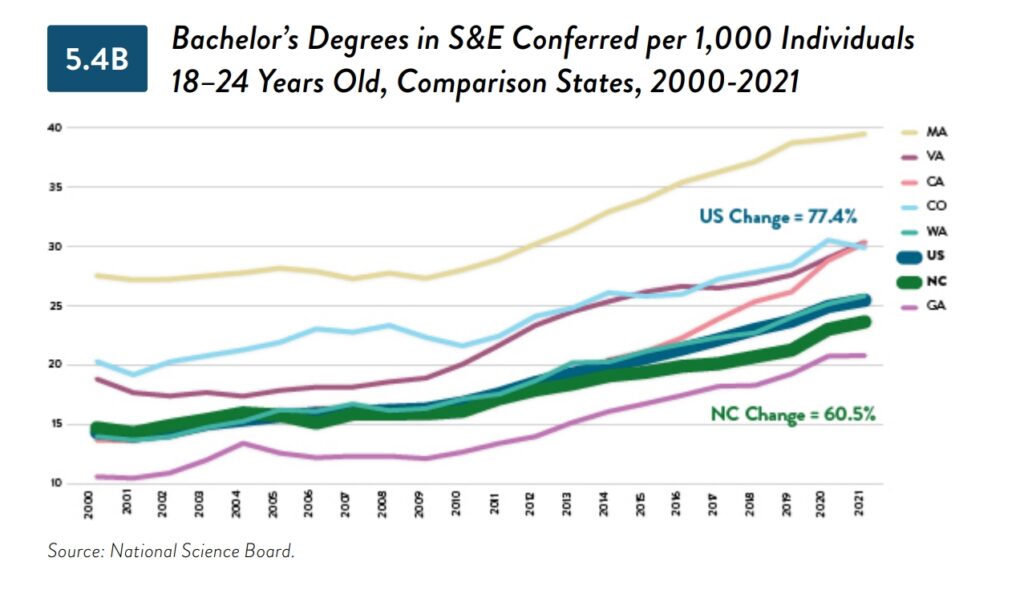
An educated, skilled workforce is viewed as a key to success in an innovative economy, the report said.
North Carolina ranks 21st in the nation for educational attainment, based on a composite score that uses data for residents over the age of 25.
About 10% of North Carolinians over the age of 25 have not completed high school. A quarter of them completed their education with a high school degree, and 19.3% completed have a high school degree with some college experience. One in 10 have completed with an associate degree, 22.8% completed with a bachelor鈥檚 degree, and 13.2% completed with a graduate or professional degree.
Across North Carolina, the majority of counties have relatively low educational attainment levels, researchers found. Out of 100 counties, 83 have an educational composite score below the United States average composite score. The counties that have an above average score are either in urban areas, adjacent to universities or urban areas, or have a large number of retirees or military personnel.
North Carolina has a of reaching 2 million North Carolinians aged 25-44 with a degree or credential by 2030.
The 2011 State of the North Carolina Workforce report found that people without a high school diploma were more likely to be unemployed. It also was found that more than half of new jobs in the state required at least some postsecondary education, particularly in STEM areas.
鈥淭hese facts, combined with the educational attainment findings presented above, make it clear that North Carolina must improve the educational attainment levels of its citizens in order to generate innovative ideas, to support the expansion of a knowledge-based economy, and to increase the economic well-being and quality of life of its citizens,鈥� the Tracking Innovation report said.
Public investment in education is a part of environmental and infrastructure measures in the report.
Based on data gathered between 2001 and 2022, the report found that North Carolina has decreased state funding for higher education. It has also spent less on elementary and secondary education.
Between 2002 and 2021, the entire country鈥檚 average elementary and secondary public school current expenditures as a percentage of state gross domestic product decreased by 5.3%. North Carolina鈥檚 percentage decreased by 12.9%.
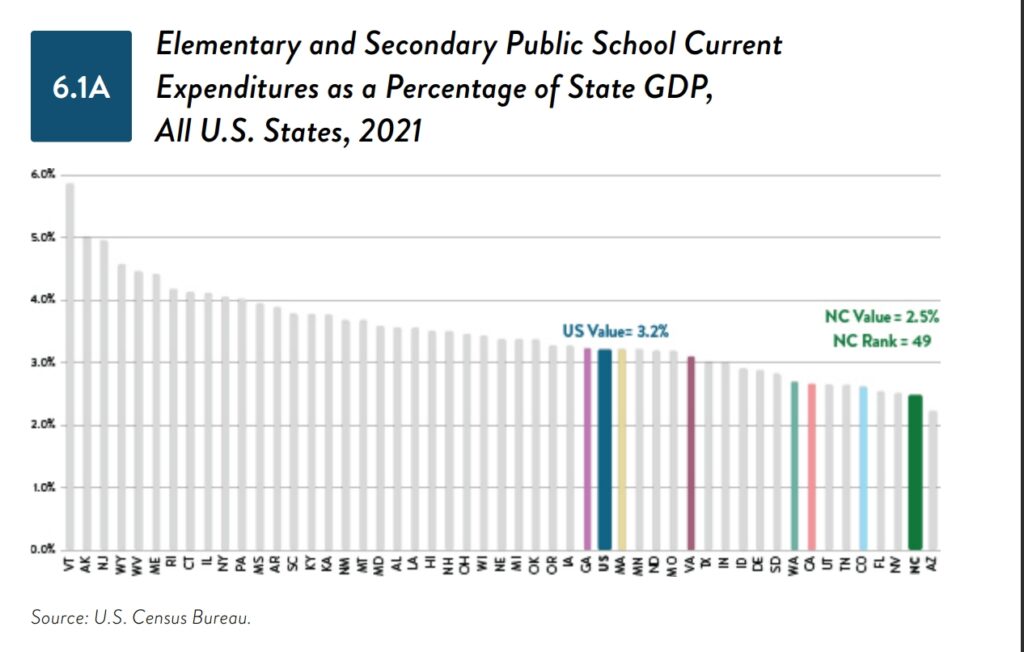 Courtesy of .
鈥淔or each measure, a higher value indicates that a state has made financial support of the respective education level more of a priority. Investments in public pre-kindergarten through grade 12 are important for preparing a broadly educated and innovation-capable workforce,鈥� the report said. 鈥淚nvestments in public postsecondary education are critical to increase the ability of public academic institutions to prepare students for skilled and well-paying employment.”
This first appeared on and is republished here under a Creative Commons license.
Did you use this article in your work?
We鈥檇 love to hear how 社区黑料鈥檚 reporting is helping educators, researchers, and policymakers.