Is Wikipedia a Good Source? 2 College Librarians Explain the Online Encyclopedia
Some professors now assign Wikipedia editing as an alternative to the traditional research paper

;)
Education news and commentary, delivered right to your inbox.
Sign up for 社区黑料 newsletter.
Get stories like this delivered straight to your inbox. Sign up for 社区黑料 Newsletter
What comes to mind when you think of Wikipedia?
Maybe you think of clicking link after link to learn about a topic, followed by another topic and then another. Or maybe you鈥檝e heard a teacher or librarian tell you that what you read on Wikipedia isn鈥檛 reliable.
As and , we know people have concerns about using Wikipedia in academic work. And yet, in interacting with undergraduate and graduate students doing various kinds of research, we also see how Wikipedia can be an important source for background information, topic development and locating further information.
What exactly is Wikipedia?
, which is a free online encyclopedia run by the nonprofit Wikimedia Foundation and written collaboratively by its users.
and for contributing to the site. The five pillars establish Wikipedia as a free online encyclopedia, with articles that are accurate and cite reliable sources, and editors 鈥� called Wikipedians 鈥� who avoid bias and treat one another with respect.
build upon the five pillars by establishing best practices for writing and editing on Wikipedia. Common issues that go against the guidelines, for example, include and , which refers to editing an article in an intentionally malicious, offensive or libelous way.
Here are what we see as the main pros and cons to college students using Wikipedia as a source of information in their research and assignments, though anyone can consider these tips when using Wikipedia.
Wikipedia鈥檚 strengths
1. Basic information on virtually any topic
In addition to being free and readily available, Wikipedia鈥檚 standardized and hyperlinks to other articles enable readers to quickly track down the basics on their topic 鈥� the who, what, when, where and why.
In our experience, many students come to the library with a chosen topic 鈥� for example, voting rights during Reconstruction 鈥� but little knowledge about it. Before searching for the scholarly articles and books typically needed to complete their assignment, students benefit from knowing keywords and concepts related to their topic. This ensures they can try a variety of words and phrases in the catalog and databases as part of their search strategy.
2. Notes and references encourage readers to go deeper
The is a real browsing behavior of endlessly hopping from topic to topic, which is a testament to the site鈥檚 easy navigation. Students can find valuable information such as important scholars on the topic by scrolling to the 鈥淣otes鈥� and 鈥淩eferences鈥� sections of the Wikipedia page. Here they can find out who authored the various sources used in the article, as well as the citation information needed to locate additional books and articles.
3. Students can be editors
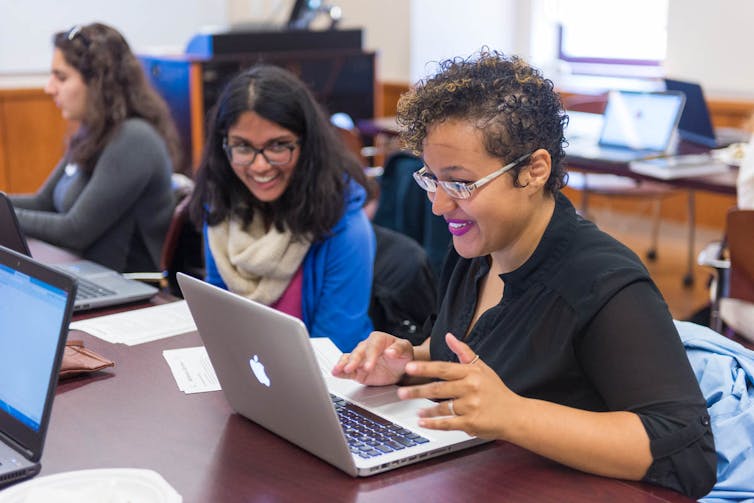
Students can write content, share information and properly cite scholarly sources on Wikipedia by becoming an editor. Quick-acting editors can become the first to add changes to an article . Those of us with access to scholarly sources, both in print and online through libraries, by sharing information that might otherwise be behind a paywall.
are events at which people gather to edit articles on topics of interest or that might otherwise be ignored. American universities have hosted edit-a-thons on , and .
Some as an alternative to the traditional research paper. This practice engages students in digital literacy and teaches them .
Wikipedia鈥檚 drawbacks
1. Systemic and gender bias
The crowdsourced nature of Wikipedia can lead to the exclusion of some voices and topics. Although anyone can edit, not everyone does.
On the issue of , Wikipedia acknowledges that most contributors are male, few biographies are about women, and topics of interest to women receive less coverage. This dynamic can be observed in other areas of underrepresentation, especially race and ethnicity. Nearly , which leads to missing topics, perspectives and sources.
2. Citation requirements can exclude important sources
Wikipedia requires that information included in an article was . While this is often an important element to confirm something is true or correct, it can be limiting for topics that have not received coverage in newspapers or scholarly journals. For some topics, such as Indigenous peoples of Canada, an may be an important source, but it could not be cited in a Wikipedia article.
3. Not all cited sources are open-access
Some sources may be behind paywalls, and since citations , academic publishers have a vested interest in their publications鈥� being cited, whether or not they are freely available. However, college students can use their school鈥檚 library to get full text access to the sources they discover in Wikipedia articles.
4. Articles change frequently
While timely updates are an advantage of Wikipedia, the impermanence of articles can make them difficult to rely on for information. Students can keep track of the date they find a piece of information on Wikipedia as it might not be the same when they return. The 鈥淭alk鈥� page of a Wikipedia entry provides a discussion of changes to the article, and the can be used to view previous versions.
This article is republished from under a Creative Commons license. Read the .

Did you use this article in your work?
We鈥檇 love to hear how 社区黑料鈥檚 reporting is helping educators, researchers, and policymakers.