Librarians Help Students Navigate an Age of Misinformation — But Schools Are Cutting Their Numbers

;)
Education news and commentary, delivered right to your inbox.
Sign up for ÉçÇøºÚÁÏ newsletter.
Get stories like this delivered straight to your inbox. Sign up for ÉçÇøºÚÁÏ Newsletter
School librarians hear the question all the time: Why do we need school libraries and school librarians when students have the internet?
The perception is that a computer and Wi-Fi are all students need for their informational and recreational needs.
Meanwhile, the number of school librarians in the U.S. has over the past decade, according to a July 2021 study funded by the . Many states, including Arizona, Texas and Pennsylvania, . And an analysis from the revealed that Hispanic, nonwhite and nonnative English speakers are the students most affected by the decline in librarian positions.
“Access to school librarians has become a major educational equity issue,� says , who with led the IMLS study. In a recent email he told me, “School districts losing librarians tend to be ones that can least afford the loss in a society characterized by increasing economic inequality.�
As a former school librarian who and , I know that demonstrate that K-12 school librarians have a significant impact on student achievement.
Here are four functions that school librarians carry out that I believe make their role more important now than ever.
1 Foster digital literacy
As bestselling author put it, “Google can bring you back 100,000 answers. A librarian can bring you back the right one.�
Recently, there has been an alarming rise in . This is . A 2016 Stanford University study found that nearly 80% of high school students of a source.
A 2012 Pew Research study revealed that think the amount of information available online today is “overwhelming for most students.� Over 70% believe that today’s digital technologies “discourage students from finding and using a wide range of sources for their research.�
School librarians are information literacy experts trained to teach students how to access and navigate the tsunami of digital information available to them, and how to determine the authenticity of that information.
2 Champion the joy of reading
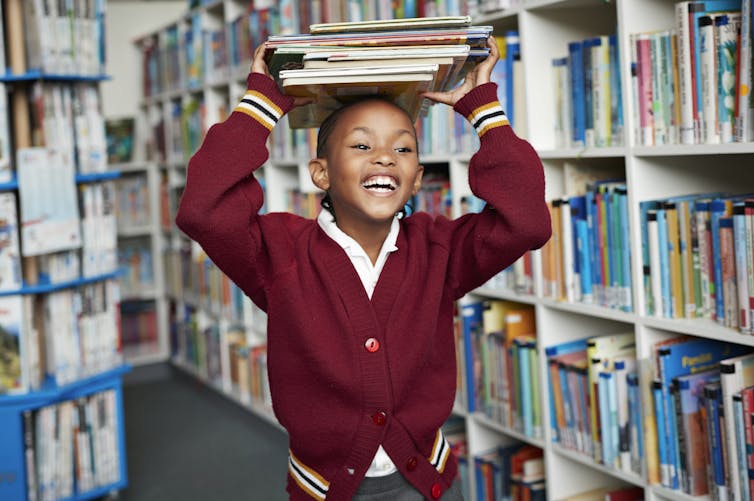
School librarians collect and curate high-quality print and digital materials that help students develop a lifelong love of reading. Take, for example, , librarian at in Piedmont, South Carolina, and winner of the American Library Association’s in 2018. Cox partnered with the county election commission to bring in voting machines for a book award contest to creatively encourage both reading and civic education.
Findings from studies such as the 2014 South Carolina Association of School Librarians’ affirm that students who attend schools with full-time certified school librarians on standardized reading tests.
3 Help teachers enhance their lessons
School librarians  to locate resources that enhance and support authentic classroom instruction. For example, Cindy Symonds, the librarian at  in Blythewood, South Carolina, collaborated with fourth-grade teachers to have students use databases to research a historic weather event, such as  in 2005 or the  in 2011. Then, with the help of a technology instructor, the students filmed themselves using a  to create a weather report.
School librarians also work to ensure that students are taught issues of . They collaborate with teachers to help students understand the ethical use of ideas and information. These include lessons about acknowledging authorship, properly citing content and developing an understanding of how to correctly use and reproduce others’ work.
4 Seek out creative, diverse materials
School librarians select inclusive materials that represent diverse points of views. This ensures that students have materials that reflect their own experiences as well as the experiences of others.
Librarians often provide innovative and creative programs that promote where students share ideas, equipment and knowledge while they work on projects. For example, during Hispanic Heritage month, the students at in Charleston, South Carolina, read books by Latino authors and researched the authors’ countries of origin. They also , such as national flags and maps with landmarks and used invention kits to code and present their facts on interactive displays. The project combined research, literacy, coding, circuitry, self-expression and creativity.
, who oversaw the project, says observers might be “taken aback by my library’s apparent disorder, the lack of desks, the constant movement of students, cardboard everywhere, the constant chatter and the energy level.�
“But,� Herold adds, “spend more than a cursory look, more than a quick investigation and you will find the future of education.�
This article is republished from under a Creative Commons license. Read the .

Did you use this article in your work?
We’d love to hear how ÉçÇøºÚÁÏ’s reporting is helping educators, researchers, and policymakers.