
Mississippi鈥檚 Childcare Crisis Has Surpassed a Year. Does the State Have a Solution?
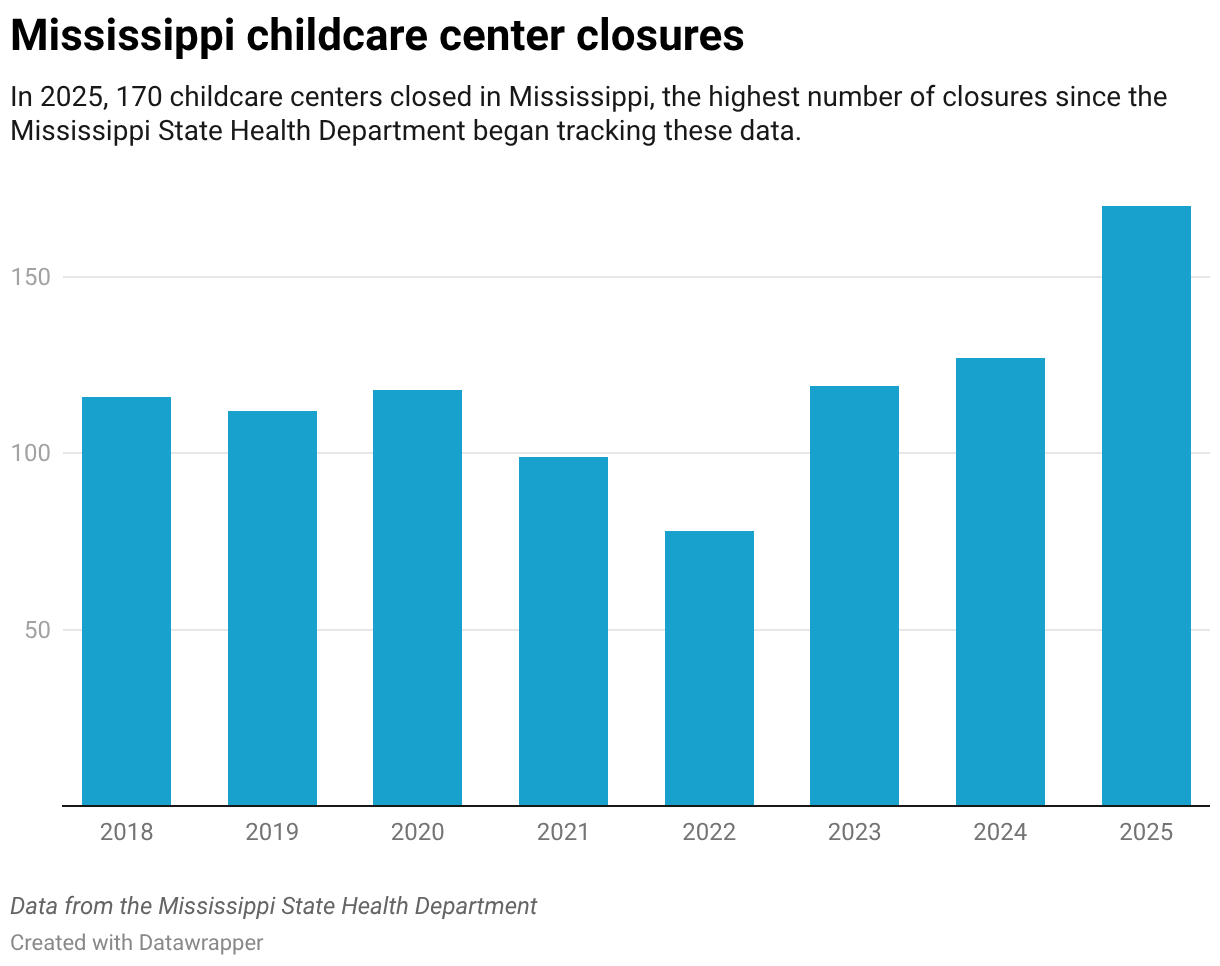
Last year saw the greatest number of closures in nearly a decade, as 170 centers were shuttered.

;)
Education news and commentary, delivered right to your inbox.
Sign up for 社区黑料 newsletter.
Join our zero2eight Substack community for more discussion about the latest news in early care and education.
Nancy Burnside has devoted three decades to caring for children. At age 46, she jokes that she tried to leave the industry several times to pursue careers in retail and event planning, but she always came back to early childhood education.聽
In 2015, Burnside returned to her home state from Georgia and reopened her parents鈥� Kosciusko childcare center, now called 3 Steps Daycare. She knew running the family business would be more of a passion than a lucrative job, but she never imagined things would be so hard.
鈥淢y mom worked 16-hour days,鈥� Burnside said. 鈥淚 grew up in this industry 鈥� But this is the worst I鈥檝e seen it.鈥�
Over the last year, 75 of the 200 children attending her daycare dropped out. Those kids were all on the state鈥檚 voucher program, which helps low-income families access childcare that makes working possible. Burnside is losing $28,000 a month, hasn鈥檛 taken a salary in two years and is providing free care for five children whose families cannot pay, as well as discounted care for an additional seven children.
Burnside鈥檚 center is suffering like 89% of centers recently from the Mississippi Low-Income Child Care Initiative. One year after the state ran out of pandemic-era funds that propped up a fragile system, hundreds of childcare providers across Mississippi struggle to stay open while thousands of parents remain on a waiting list for vouchers. Last year saw the greatest number of closures in nearly a decade, as .
Out of 229 centers surveyed in the report, more than half reported having to terminate staff as a result of the pause, and nearly half reported caring for children whose parents weren鈥檛 paying.
鈥淲hen you walk through, everybody says, 鈥榊our building is full.鈥� I know it鈥檚 full 鈥� that鈥檚 because I鈥檓 not charging,鈥� Burnside said.
Despite and advocates, the Mississippi Legislature failed to allocate any money toward the state鈥檚 childcare voucher program.
If the state doesn鈥檛 put up money for the program, centers will continue to close.
Burnside can鈥檛 fathom why Mississippi doesn鈥檛 prioritize early childhood education, especially in a crisis of this magnitude. She said there is a misconception that her work is babysitting. She said she has only ever thought of her center as a learning institution. It鈥檚 where children master life skills as simple as tying their shoes and as fundamental as making their first friends.
鈥淭his is where they start,鈥� Burnside said. 鈥淚 don鈥檛 know anything else more important.鈥�

Darren Brewer, a single father born and raised in Kosciusko, knows firsthand the importance of quality childcare. Brewer pays out of pocket for the care his 2-year-old daughter receives at Burnside鈥檚 center, but he believes he may qualify for vouchers now that his family is down to one income. He hopes to apply once the waiting list is resolved. Brewer applauds the center鈥檚 staff for recognizing early symptoms of ADHD and autism in his son, now 5, and for referring him to further testing.
鈥淚t helped us with the doctors to know what to do and all that,鈥� Brewer said.
Brewer recognizes the importance of that early intervention, along with the countless birthday parties, graduations and everyday acts of love that have taken place at the center.
鈥淢s. Nancy helps more people out than anybody in this town,鈥� Brewer said.
A potential solution that could be 鈥榟uge鈥�
Mississippi鈥檚 parents and childcare providers have one last hope for restoring money to the voucher program 鈥� a funding model that advocates proposed last year. That model would put unused money from the federal program called Temporary Assistance for Needy Families toward the childcare voucher program.
The Mississippi Department of Human Services is the agency overseeing the voucher program. For months, officials there said it was not possible to use more TANF money than the state already devoted to childcare. Currently, Mississippi transfers the maximum 30% of TANF funds to the state-run voucher program.
However, advocates have pointed to other states that have legitimately and successfully transferred additional money by creating a revenue stream that utilizes TANF funds separate from the 30% limit.
In January, department officials and said they were 鈥渆xploring鈥� the funding model.
Now, Mark Jones, chief communications officer at MDHS, says the agency is finalizing a plan to use advocates鈥� model. The department has not made an official announcement. Jones would not say how much money his department would allocate or how many families the additional money would serve.
Jones estimates that $60 million is needed to resolve the waiting list. Before the Legislature decided against it, lawmakers to the voucher program. Advocates say that while any amount will help, families and educators will continue to suffer if the state doesn鈥檛 put up the full amount.
鈥淎s long as we have that waiting list, we know that children, working parents and providers are going to continue to struggle,鈥� said Matt Williams, director of research at the Mississippi Low-Income Child Care Initiative.

Still, Williams believes any allocation of money through this new TANF model would help establish the framework for the state to access more funds for the voucher program in the future. He said the implementation of this funding model would be a 鈥渉uge, positive development.鈥�
At the height of the crisis, the department reported a waiting list of 20,000 families. On April 22, Jones amended that number, saying it included duplicates and that there are currently 9,400 families waiting for vouchers.
Even when the system is not in crisis, it is a far cry from reaching all the people for whom it was designed. Many families don鈥檛 know they qualify, or they may fall off the program due to red tape.
Experts in Mississippi do not have solid estimates about how many eligible families go without care. But across the country, the voucher program eligible families, leaving far more without needed help in covering childcare costs.
Meanwhile, Burnside doesn鈥檛 think she can make it past January if the families she works with don鈥檛 regain lost vouchers. She knows that closing would be an enormous loss for her community, where her center has been a lifeline for generations.

Today, she serves many of the children of Kosciusko natives who attended the center when her parents owned it. She鈥檚 watched parents dropping off their kids become grandparents dropping off their grandkids.
鈥淚鈥檓 like, 鈥業 bet you didn鈥檛 think you would never come back on this road,鈥欌�� Burnside laughed. 鈥淏ut they do.鈥�
If her business is forced to shut down, she does not know where those caregivers will go to continue working and supporting their families.
This first appeared on and is republished here under a .
Did you use this article in your work?
We鈥檇 love to hear how 社区黑料鈥檚 reporting is helping educators, researchers, and policymakers.